Why Are HR Operations Still Disconnected? The Real Root of the Divide
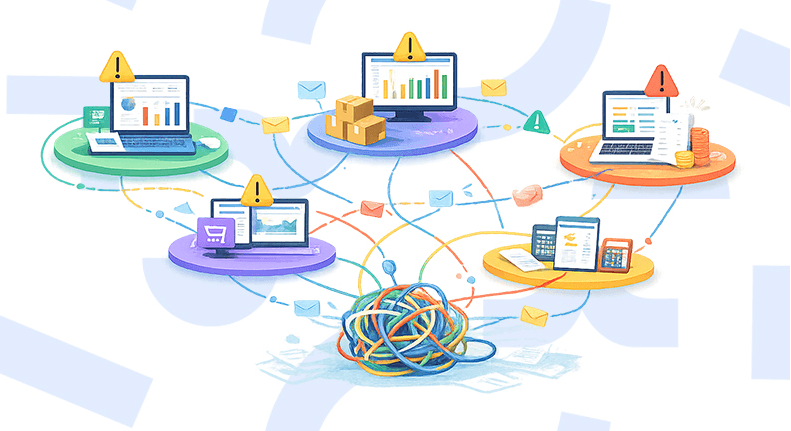
A company’s payroll software was purchased in 2018. Leave tracking was added in 2021 because Excel spreadsheets could no longer keep up. The training platform rolled out last year after an audit flagged missing compliance records. Each was the right call in its own moment. Yet today, when all three operate side by side, the same employee's profile lives in three different places, formatted in three different ways.
This scenario is no accident; it is the natural byproduct of how HR technology typically evolves. According to analysis by Second Talent, HR tech rarely arrives in a single big bang—it accumulates quietly, tool by tool, decision by decision, usually as a quick fix for an immediate pain point. Recruiting prioritizes speed, payroll demands accuracy, and training requires scale. While every individual system delivers standalone value, none are selected with the holistic architecture in mind.
That is why the answer to "why is it still disconnected?" is rarely organizational neglect. Rather, every tool was a sensible purchase in its own right, but no one planned for how they would interact once placed in the same room.
Why Don't Systems Talk to Each Other?
According to the same research, companies utilized an average of 6.2 HR systems in 2020—a figure that climbed to 9.1 by 2024. This increase is driven not by replacing platforms, but by continuously layering new tools on top of old ones. Compounding the problem, only 39 percent of these systems are integrated in a genuinely functional way.
The logic behind these figures is straightforward. Each system solves a specific problem at the point of purchase, but integration is rarely the immediate priority. When selecting a payroll engine, the decisive question is: "Does it calculate payroll accurately?"—not "Does it talk seamlessly to the leave management module?" Because the question is never asked, the capability is missing from day one.
The result is a landscape where systems perform well in isolation while humans bridge the gaps between them. An employee's details are manually keyed into payroll, entered again into the leave system, and inputted once more into the training database. Every single entry point becomes an opportunity for human error.
Being Digital Does Not Mean Being Connected
A process taking place on a screen does not mean it operates automatically or in sync. Consider a new hire’s first week: employee records are created in one platform, equipment requisitions run through a separate channel, compliance training is assigned via a third tool, and the direct manager tracks milestones on an offline checklist.
Every step is digital, yet the thread holding them together remains reliant on human memory. The HR team monitors who finished what, flags bottlenecks, and chases down missing steps. A process that is technically digitalized remains, at an operational level, running on emails, post-it notes, and individual recall.
Where the True Cost of Fragmentation Hides
This cost often goes unnoticed because it never appears as a single line item. In an organization running on fragmented systems, employees spend a substantial portion of their working week tracking down information. A massive chunk of this time is eaten up by manually transferring data that technology should be synchronizing in the background.
The tangible fallout is all too familiar: an onboarding workflow stalls because no one automated the handoff between offer acceptance and workstation provisioning, requiring someone to notice and trigger it by hand. An audit exposes a compliance vulnerability because the LMS and personnel files do not communicate, meaning compliance reports only exist when someone remembers to generate them manually.
These breakdowns demonstrate that the cost of disconnected systems is rarely a single catastrophic failure; it is the steady, cumulative drag of perpetual administrative friction.
Is Moving Everything to an All-in-One Platform the Answer?
The intuitive response is often: "Migrate everything into a single platform." In practice, the reality is far more nuanced. Research by HR.com reveals that only 13 percent of companies rely on a single, comprehensive suite; the rest deliberately opt for best-of-breed combinations because no mega-platform excels at every function with equal depth.
This does not mean moving to a single platform is mistaken, but an all-in-one suite is not a silver bullet. The essential question is identifying which tools must share core employee records (employee identity, leave balances, payroll history) and which can operate independently. Forcing every peripheral tool under one giant umbrella can quickly turn into a costly, protracted migration that creates more friction than the original disconnect.
Acknowledging a Boundary
Transparency matters here. An integrated system can eliminate the bulk of operational disconnects, but not every fracture stems from software. Often, the roadblock is organizational ambiguity around data ownership: HR considers a specific dataset their domain, while finance treats that same data as their responsibility. These ownership disputes cannot be solved automatically by even the most sophisticated platform; they require an upfront organizational decision.
Building a truly connected HR ecosystem therefore rests on two distinct pillars: first, an underlying infrastructure that maintains core data in a single, authoritative source of truth; second, a clear organizational consensus detailing data ownership and governance. Without both, the model remains incomplete.
Where to Begin?
Attempting to resolve every systemic gap at once typically overwhelms the project before it starts. A healthier strategy is to begin where friction is highest—frequently at cross-functional handoffs like onboarding, where multiple departments intersect simultaneously. Establishing operational clarity here builds both confidence and a working blueprint for subsequent phases.
From there, functions that rely heavily on core records—such as payroll, time tracking, and leave management—can be unified. More specialized workflows, such as performance management and specialized learning platforms, can continue running independently, provided they remain synced with master employee records.
Unifying Core Data with Ming
Ming runs essential operational workflows—including payroll, leave tracking, time and attendance, training, and internal staff communication—off a single unified employee profile. When an employee’s leave status updates, the change flows directly to payroll without duplicate data entry; when training is completed, records log straight into the employee’s central file.
This does not require consolidating your company's entire enterprise IT or ERP landscape under one roof; it simply means the core HR and operational workflows covered by Ming communicate natively, consistently, and without friction.
If your company's HR operations are still scattered across disconnected tools, reach out to us at mingapp.co/contact to explore which workflows will deliver the greatest impact when brought together.
Employees submit requests from their phone and approvals flow through Ming. If you have an HR or ERP system, Ming connects to it; if not, you run the processes directly in Ming.